Practice & Discussion
Quick Check
Inquiry Task
What can be confirmed: the questioners differ (Yan Yuan, Zhonggong, Sima Niu, Fan Chi, etc.), Confucius's answers differ, and the relevant passages are scattered across different sections. It can also be confirmed that the Analects contains dialogues among the disciples and remarks by fellow students. What cannot be directly confirmed from the materials are Confucius's tone, facial expression, or unstated inner thoughts.
They should be explained in light of the listener's aptitude, temperament, and circumstances. Confucius answered each disciple differently, embodying the principle of teaching according to the student's ability. When reading an aphorism, first reconstruct who the questioner was and in what situation the question was asked, then understand the answer within that context—rather than treating a single statement as a universally valid conclusion.
The limitations include: these materials are only part of the Analects, and one cannot determine the complete system of Confucius's philosophy of "benevolence" from just a few dialogues; chapter titles do not summarize themes, so relevant chapters throughout the book need to be gathered together; the version we see today has undergone centuries of editing and annotation, and early excavated materials may also be consulted. To make further judgments, one needs to read the relevant chapters throughout the book thoroughly, rely primarily on the Analects itself as evidence, and avoid directly applying fully developed later concepts to interpret it.
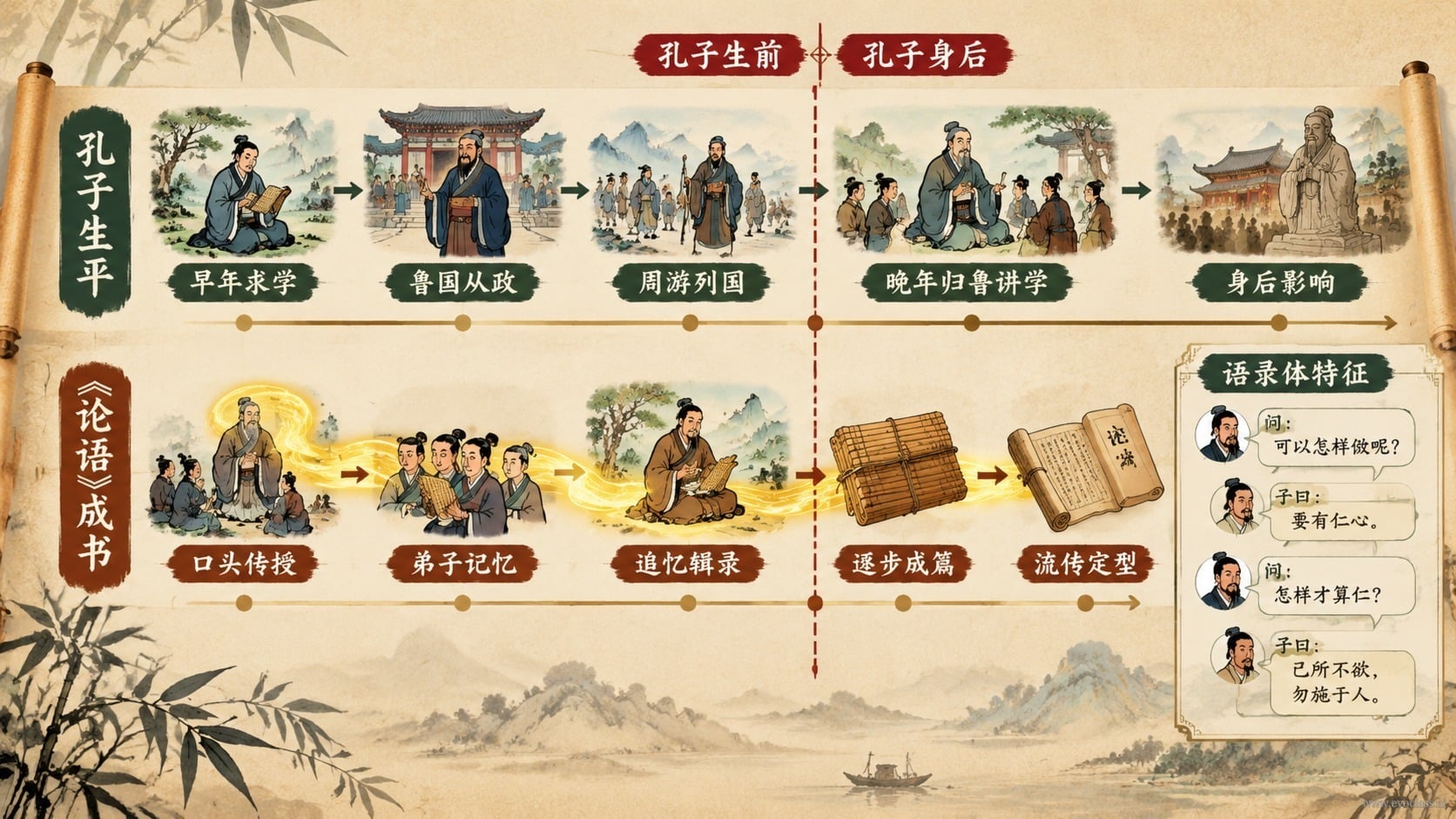
The Analects is not a systematic work written by Confucius himself, but rather a record of the words and deeds of Confucius and his disciples—an aphoristic classic. It was compiled gradually by the disciples of Confucius and their successors, with the chapters taking shape around the early Warring States period. It survives in twenty sections and over four hundred chapters. Confucius described himself as "transmitting rather than creating" and left no writings of his own; therefore, when reading, one must first ask: Who said this? To whom was it said? Under what circumstances was it said?
Understanding the main stages of Confucius's life helps place his aphorisms back into specific teaching and conversational settings. Confucius lived from the mid-sixth century to the early fifth century BCE and was a native of Zou in the state of Lu. His family was not well-off in his early years, and he served as a minor official managing granaries and livestock. In middle age he began gathering students and teaching. In his fifties he briefly held office in Lu, then led his disciples on a tour of various states for over a decade. In his later years he returned to Lu, where he organized classical texts and taught his followers.
The learning objectives of this page are: to explain the process by which the Analects was compiled by the disciples and their successors and its characteristics as an aphoristic text; to describe the main stages of Confucius's life and point out their connection to the content of the text.
The aphoristic style records words and deeds through brief dialogues and fragmentary remarks, usually without systematic argumentation. The Analects consists of twenty sections, and the section titles are mostly taken from the opening words of the first chapter in each section, such as "Xue Er," "Wei Zheng," and "Li Ren." These titles are merely labels and do not summarize the theme of the whole section; materials on the same theme are often scattered across different sections. For example, passages on "benevolence" appear not only in "Yan Yuan" but also in "Li Ren," "Yong Ye," "Wei Ling Gong," and others.
What the book records is not limited to Confucius himself; it also includes dialogues among the disciples and remarks by fellow students. Therefore, when reading an aphorism, one must first distinguish the speaker: which are the words of Confucius, which are the words of the disciples, and which may be later followers' recollections. To read the Analects as a whole, one needs to gather relevant passages for comparison, rather than seeking understanding based solely on section titles.
There are three key methods for reading the Analects: First, reconstruct the context. On the same question, Confucius gave different answers to Yan Yuan, Zhonggong, Sima Niu, Fan Chi, and others because the listeners' aptitudes and circumstances differed. First determine who the questioner was and in what situation the question was asked, then judge the weight of the statement. Second, distinguish textual layers: the words of Confucius himself, the words of the disciples, and later followers' recollections differ in reliability and interpretive value. Third, cross-textual comparison: works such as the Book of Rites and Mencius can aid understanding, but the chapters of the Analects itself should be the primary basis.
At the same time, one must be aware of the limitations of judgment. The Analects underwent long-term editing and annotation. During the Han dynasty there were the Lu, Qi, and Ancient versions, with slight differences in the number and order of sections. After Zhang Yu, Zheng Xuan, and others edited it, a standardized edition gradually took shape, and in the Southern Song dynasty Zhu Xi grouped it with the Great Learning, the Doctrine of the Mean, and Mencius as the "Four Books." Since the twentieth century, manuscript copies of the Analects have been found among bamboo slips unearthed from a Han dynasty tomb in Dingzhou, Hebei, and the tomb of the Marquis of Haihun in Jiangxi, providing physical clues for examining early texts and reminding us that the version we read today is the result of long-term editing.
Integrated Exercise: Find a dialogue in the Analects about "asking about benevolence" or "asking about governance." First identify the questioner and Confucius's answer, then explain how the context of this dialogue affects your understanding of the answer. Finally, point out what cannot be determined from this single passage alone.